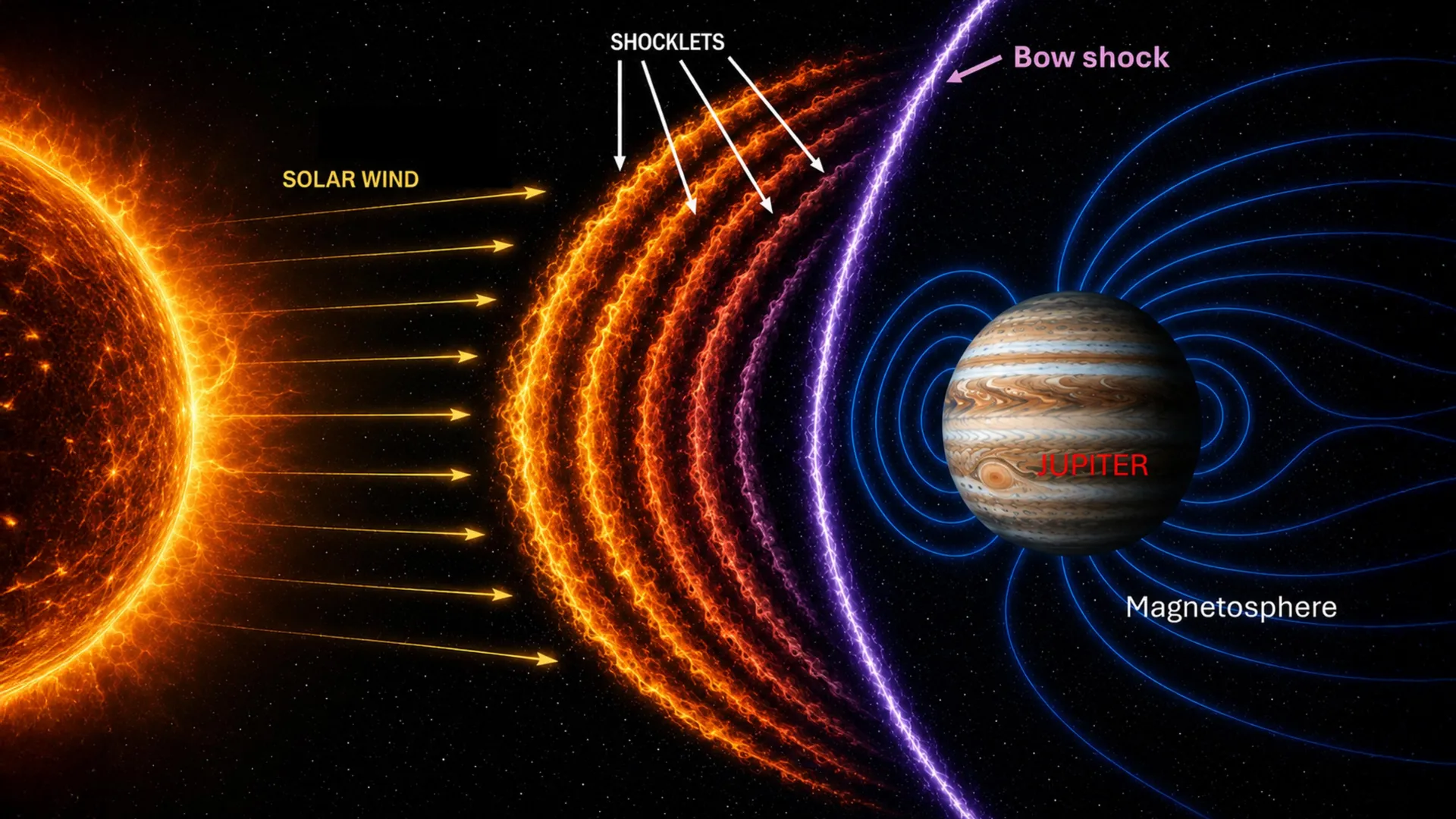
NASA's Juno spacecraft has given scientists a detailed look at how Jupiter holds off the solar wind, and the picture is more intricate than the one at Earth. Research led by the University of Iowa found that the giant planet slows and heats incoming solar particles using plasma waves spread across several frequencies, along with smaller shock structures ahead of its main boundary. Science Daily reported the findings on 29 October 2026.
The work centres on Jupiter's bow shock, an invisible frontier where the stream of charged particles from the Sun meets the planet's magnetic environment. The study was published online on 31 July in a journal identified in the source material only as "Na," and draws on Juno observations collected in December 2024.
Why it matters
The bow shock at Earth performs a protective function. It decelerates and warms particles arriving from the Sun and diverts much of the flow around the planet, limiting how much harmful material reaches the atmosphere. Science Daily notes that without this process, conditions on Earth could be less favourable for life.
Jupiter's bow shock has drawn interest because of the planet's sheer size, its strong magnetic field and its gaseous makeup. Researchers have wanted to know whether the largest planet in the solar system handles the solar wind the same way Earth does, and what any differences might say about shock waves elsewhere in the universe.
The new results suggest Jupiter's approach is more elaborate. According to Science Daily, the findings could also inform understanding of far more violent shocks, including those tied to exploding stars.
Harmonics instead of a single note
At Earth, the bow shock largely relies on plasma waves grouped around one frequency. That arrangement is generally enough for conditions near our planet.
Juno's measurements indicate Jupiter instead uses waves at multiple frequencies, known as harmonics. The overlapping frequencies produce a more complex wave pattern, and the researchers say this lets the bow shock hand energy to a larger number of solar wind particles, heating them and bringing their speed down.
Jayasri Joseph, a postdoctoral researcher in Iowa's Department of Physics and Astronomy and the study's corresponding author, described the contrast in musical terms. Jupiter, Joseph said, has developed its own method for coping with the solar wind, using plasma waves that are stronger and show richer harmonic structures. The presence of several frequencies, Joseph explained, means more particles can be heated and slowed.
Smaller shocks ahead of the main boundary
The team also found a second difference in how the two planets meet the solar wind. Before particles arrive at Jupiter's primary bow shock, they can run into smaller shock regions called shocklets. These structures begin slowing the flow before it reaches the main boundary.
Earth's bow shock, by contrast, generally acts as the principal zone where the solar wind is slowed and redirected. Jupiter's extra structures point to a more layered process for managing the energy that solar particles carry.
Bill Kurth, a research scientist in the same Iowa department and a coauthor, said Earth does not need to take these additional steps because the impact it faces is not as strong. Kurth has been involved in the Juno mission since the spacecraft launched in 2011.
A nearby laboratory for distant shocks
Shock waves are common across the universe, especially where large amounts of energy are released. Some of the most extreme occur in supernova remnants, the expanding debris left when certain dying stars explode. Those shocks dwarf anything found near Jupiter, but the plasma physics governing how energy moves is thought to share key features.
Joseph said that because even stronger shocks exist around objects such as supernova remnants, Jupiter's bow shock serves as a natural laboratory close to home for studying how nature turns the energy of fast-moving flows into heat and energetic particles. Better understanding of these mechanisms could sharpen models of how shocks move energy, heat particles and shape their surroundings.
The observations were made possible by Juno's Waves instrument, which was designed and built by physicists at the University of Iowa and measures electric and magnetic wave activity. Earlier spacecraft had detected bow shocks at the outer planets, but Science Daily reports they lacked the measurements needed to resolve the structure of the plasma waves. Juno, which has orbited Jupiter since July 2016, has now provided a clearer view.
Watch for follow-up analyses of Juno's wave data, which may show whether the harmonic pattern seen in December 2024 holds across other parts of Jupiter's magnetic environment.